A little purple-headed character climbs a staircase, picks up a log, carries it upstairs, and puts it back on the way down. The whole trip takes 28 seconds. It has no face, no separate legs, and a remarkably consistent work ethic.
This grew out of a visual experiment for Hephaestus, my settlement game. Working with GPT-6 Astra, I could develop the character and its surroundings alongside the tools for generating, inspecting, and exporting them. That workflow is the part I want to keep.
The agent helped build the workshop
The arrangement was straightforward: Astra wrote and revised Python scripts, Blender built the geometry and rendered it, and local browser pages presented the results. I supplied direction and corrections as the experiment took shape.
Around that, we built a small workshop. A command could generate a model, frame it from several angles, render a contact sheet, and export editable files. The asset had its own Blender scene; the review lights, floor, and cameras lived in another. Each iteration got a fresh output directory, so earlier versions stayed available.
Once that existed, trying another pose came with a familiar review package. The next question could be about the character’s shape or movement. Camera setup had become somebody else’s very repeatable problem.
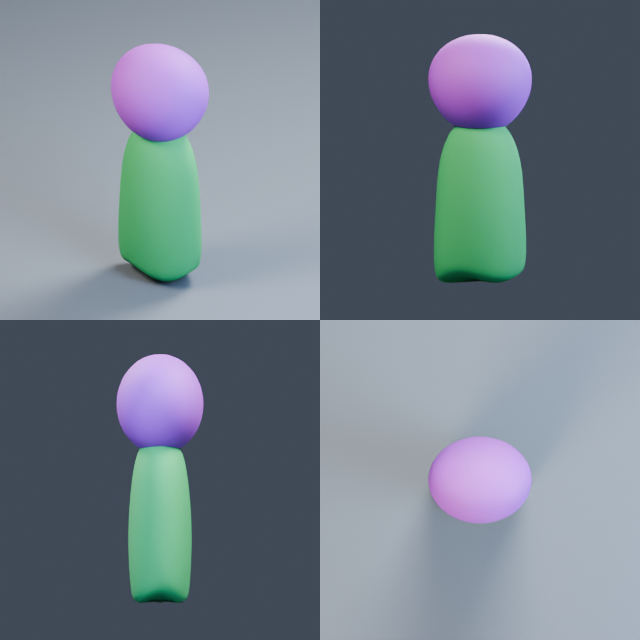
Give the work somewhere to be inspected
As the requests became more specific, the review tools grew with them. A turntable exposed the back of the stairs. A close-up made the character’s flowing hem visible. Slow motion gave the pickup enough time to explain itself.
The most useful arrangement paired a full view of the stairwell with a synchronized close-up of the pawn. The building was hidden in the close-up, so we could examine body and hand movement while still seeing where the character was on its route.
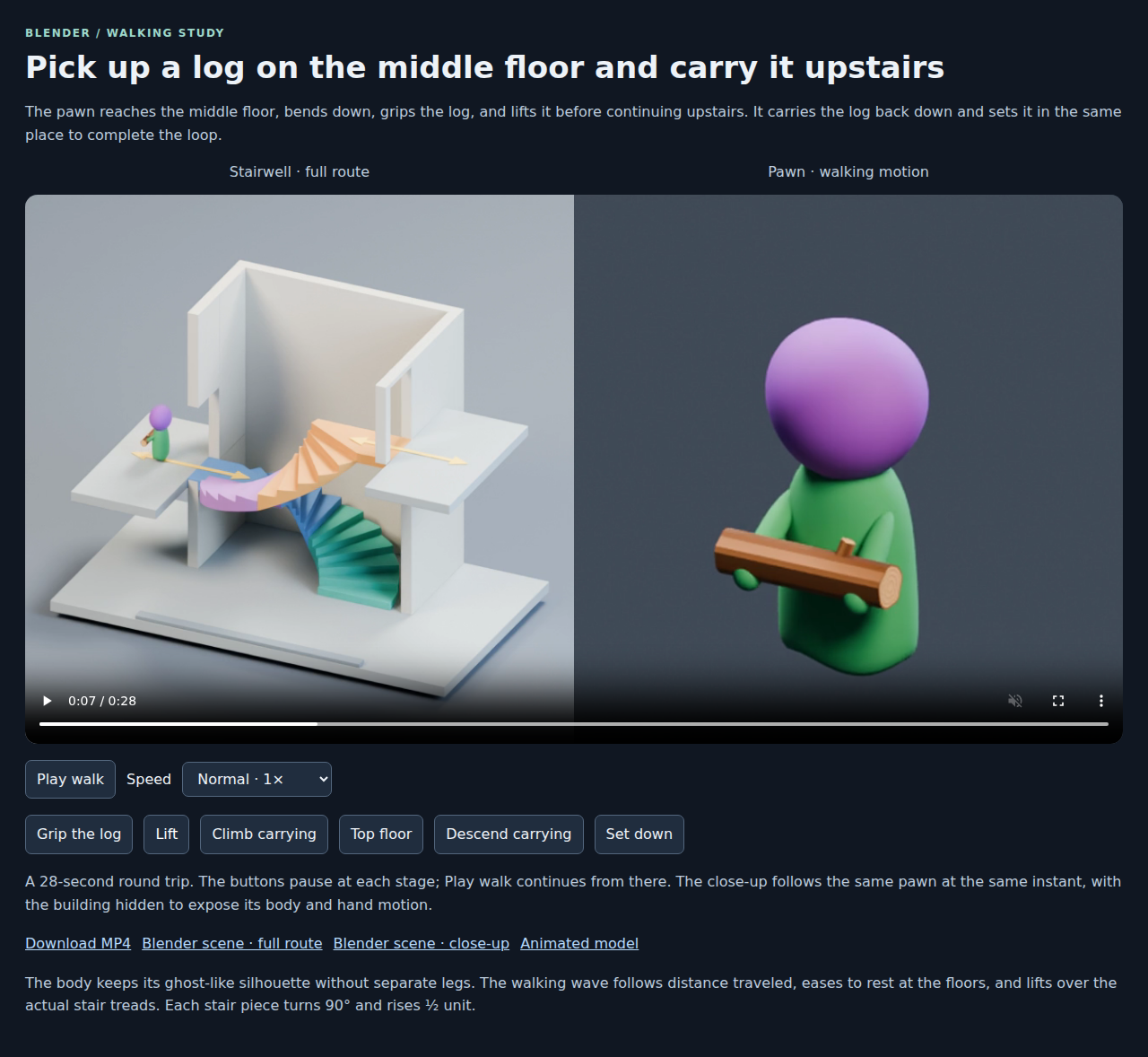
That gave feedback a location: the grip, the lift, the turn after release. Astra could work from rendered views and recorded measurements; I could judge whether the result read well. There was something concrete for the next correction to refer to.
The scripts also checked dimensions, sampled mesh intersections, and verified that the animation returned to its starting pose. Those checks answered specific geometric questions. Whether our little worker moved convincingly still deserved a look.
Even the stairs needed a second look
One correction concerned the underside of the stair slabs. The upper flights needed to meet the preceding pieces properly, and the landing, bridge, and floor needed matching lower faces.
The fix came with a better inspection view: an orbit around the complete enclosure, from a lower angle that exposed those joins. A geometry correction had also improved our ability to see the geometry.
The log added its own complications. The loaded character had to keep its compact footprint, fit through the openings, and avoid intersecting the building. After setting the log down, its flowing hem briefly gathers inward for the turn away. Even a character without trousers can have a wardrobe problem.
The assets got another job
The stairs and hauler then became shared inputs for two client prototypes: Godot and React with Babylon.js. We exported the environment and animated character as GLB files, a packaged form of the glTF 3D format. Both clients consumed the same authored study.
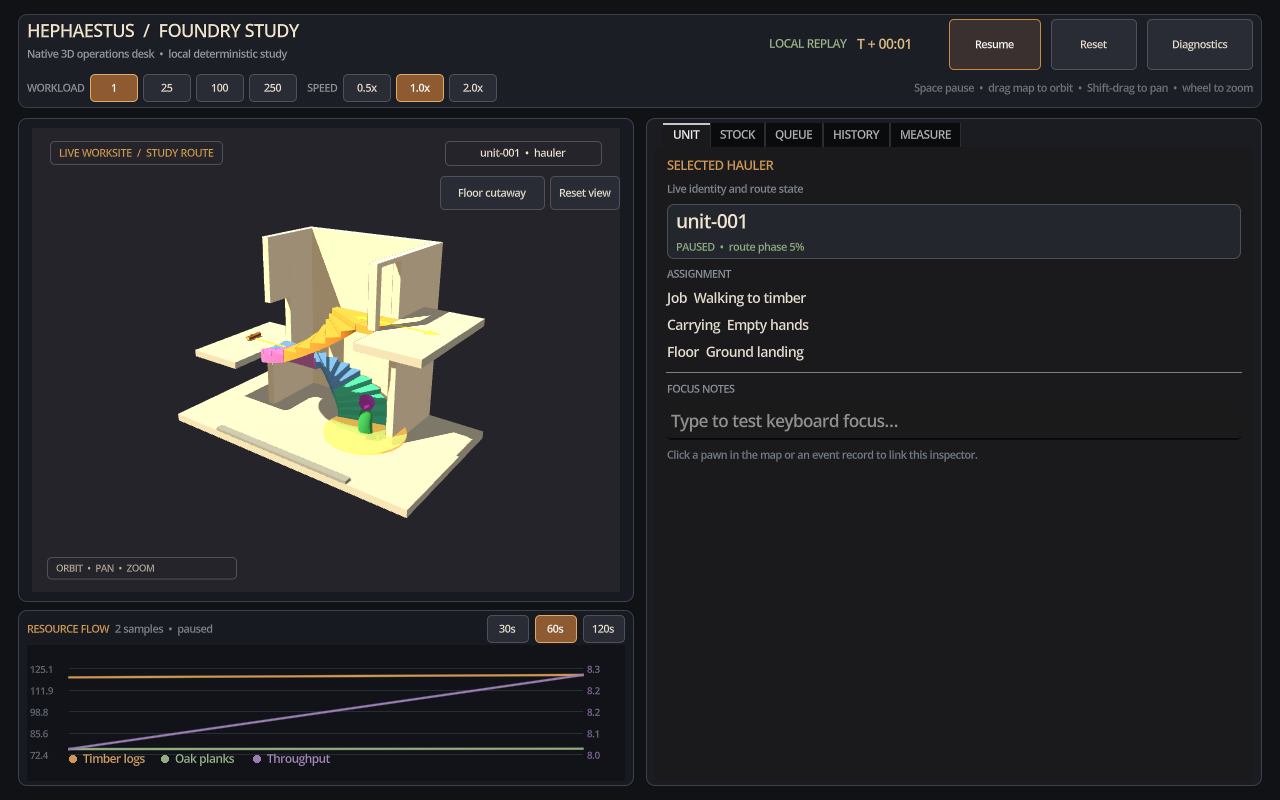
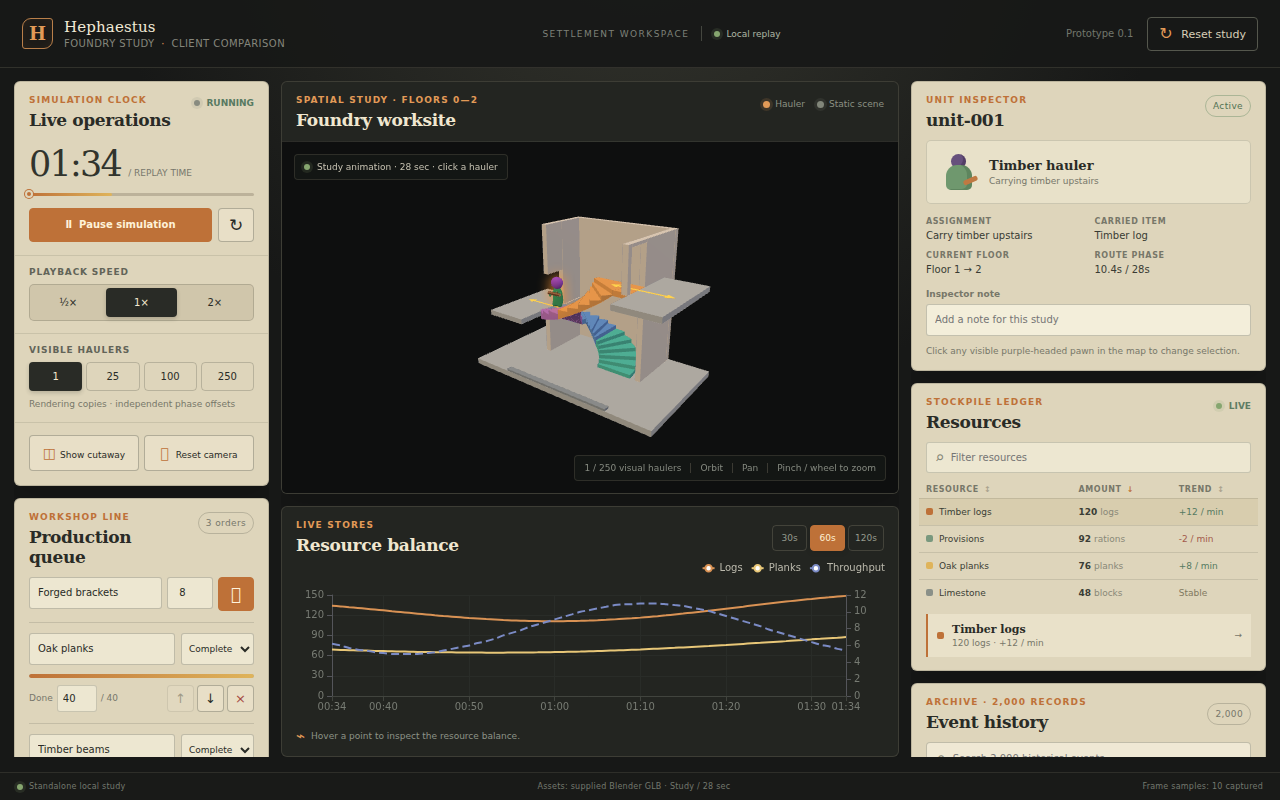
We kept the generator source and recorded the export’s source revision. That made the inputs reproducible and gave the client comparison common material to work with. Blender stayed an authoring dependency; the clients loaded the exported files.
The route was still a baked animation. Game pathfinding and simulation were separate work. But our small visual experiment now had a useful second life inside working software.
The workflow I want to keep
What stood out about working with Astra was the continuity across these jobs. A request could involve geometry, animation, a better camera angle, a review control, or an export fix. We could develop those pieces together as the experiment demanded them.
My part remained direction and judgment: what the character should look like, which movement needed attention, and whether the result was worth taking further. The growing workshop gave those decisions visible evidence and a repeatable way to act on them.
That is a workflow I can use again: make something, make it easy to inspect, refine it, and carry the useful parts into the next experiment. The little worker can keep its log. I’m keeping the workshop.